
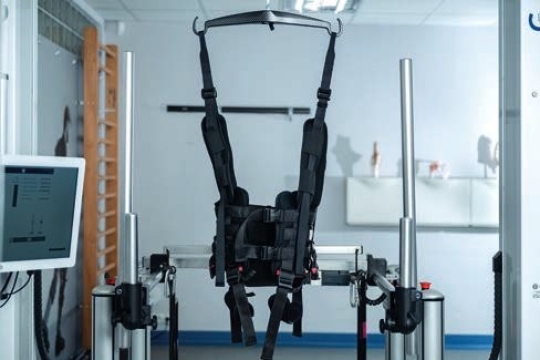
End-effector robotic gait trainer with torso and hip control, knee braces and FES.
G-EO System is an advanced robotic-assisted gait therapy device based on the end-effector principle. It simplifies therapists’ work, reduces physical strain, and supports a wide range of patients with limited movement.
Because the affected limb is secured only distally — at the feet — there are no lengthy setup steps: average patient setup is around five minutes. The device simulates a physiological gait pattern and muscle activation, and gait settings can be changed without interrupting the session.
G-EO ensures correct hip and body positioning, a key factor for lasting neurological gait rehabilitation. Mechanical torso and hip control operates in three planes (frontal, transverse, sagittal) and is adjusted in real time from the touchscreen. Mechanical knee braces give stable guidance of the knee and ankle for patients with severely limited or absent knee control (FAC 0 to 1). Functional Electrical Stimulation (FES) targets affected muscle groups and supports their activation at the right point in the gait cycle.
A 2012 study (Hesse, S. et al., JRRD Volume 49, Number 4, 2012, p. 613-622) found that patients receiving robot-assisted therapy improved twice as much in walking and stair-climbing ability compared with standard physiotherapy alone; 7 of 15 patients achieved independent walking and stair climbing after four weeks, against 1 of 15 in the control group. On step count per session, conventional therapy reaches up to 100 steps and a treadmill up to 400, while G-EO reaches up to 1400.
| Manufacturer | Technomex |
|---|


